
What Does Battery Group Size Mean?
Posted by GMI Energy on Jun 01, 2026
What Does Battery Group Size Actually Mean?
Battery group size is a standardized specification that defines the physical and electrical compatibility of a battery within its intended application. For anyone replacing or upgrading batteries, understanding what battery group size means is essential for ensuring proper fit, safe operation, and reliable performance.
This guide provides a detailed, educational overview of battery group sizes. It explains the core elements—dimensions, electrical specifications such as capacity and cranking amps, terminal types, and terminal polarity—so readers can more accurately evaluate options when searching for a replacement battery.
What Group Size Tells You About A Battery
Battery group size refers to a classification system that specifies the maximum external dimensions, terminal configuration, and general performance expectations for batteries. The designation, such as Group 31, or Group 65, indicates that batteries within the same group share a consistent physical footprint and terminal layout.
The group size does not define the internal chemistry or exact electrical ratings of a battery. Instead, it establishes a universal reference point that allows manufacturers and users to match batteries to specific compartments, trays and connection details. This standardization simplifies replacement by ensuring a correct fit in your vehicle or equipment.
The BCI Standard and Its Purpose
The Battery Council International (BCI) developed the group size system to create consistency across the industry. Prior to standardization, battery designs varied significantly, making cross-manufacturer compatibility difficult. The BCI system defines maximum allowable length, width, and height for each group, along with standardized terminal positions and polarity.
This framework continues to serve as the primary reference for automotive, powersport, and equipment batteries. It enables a user to choose between different brands, or even chemistry types and maintain compatibility with existing installations.
Dimensions – The Primary Component of Battery Group Size
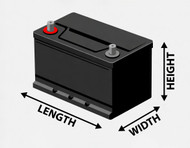
Dimensions form the foundation of battery group size. Each group specifies the maximum outer measurements a battery may have to ensure it fits securely within a designated tray or compartment. Length, width, and height are the three critical measurements that directly affect how the battery mounts, and whether terminal connections can be made without modification. In applications subject to movement—such as vehicles, RVs, boats, or powersports—precise dimensional matching prevents shifting and potential damage.
Electrical Specifications Associated with Battery Group Sizes
Electrical specifications can vary to some degree within each group size, but since the physical size is standarized, the range of these values becomes more narrow and makes comparison shopping much easier.
Amp-Hour Ratings
Amp-hour (Ah) capacity is the total energy a battery can store and deliver over time. Capacity can range widely within a given group size and should be checked to ensure the potential replacement meets or exceeds your original battery. This metric scales with group size and is particularly relevant for deep-cycle applications in RVs and marine systems.
Reserve Capacity
Expressed in minutes, Reserve Capacity (RC) indicates how long a fully charged battery can supply a standard load (usually 25 amps) before voltage drops below a usable threshold. Similar to amp-hour ratings, but measured differently and more commonly used in automotive applications.
Cranking Amps and Related Performance Metrics
Cranking amps determine a battery’s ability to deliver high current for short durations, such as engine starting. Cold Cranking Amps (CCA) measure performance at 0°F, while Marine Cranking Amps (MCA) are tested at 32°F. Larger group sizes typically support higher CCA and MCA ratings due to increased plate surface area.
Terminal Positions and Polarity
Terminal positions and polarity complete the group size specification. Polarity indicates which terminal is positive and which is negative. Many group sizes include a suffix—such as “F” or “R”—that denotes the orientation of the positive terminal when the battery is viewed from the front.
For instance, a Group 24F features reversed polarity compared to a standard Group 24. Correct terminal positioning ensures that cables reach the terminals without crossing or straining. In parallel or series configurations common to RV solar power and marine house banks, proper polarity alignment prevents reversed connections that could damage electronics or create safety hazards.
Terminal Types
The terminal types determine how the battery connects to the vehicle or system wiring but are not always dictated by the group size. If your group size comes in multiple terminal types, match this critical detail with your current batteries' type.
Common Terminals
- SAE Automotive Posts – Tapered top terminals widely used in cars and light trucks.
- Side Terminals – Threaded fittings located on the side of the battery case, common where vertical space is limited.
- Studs or Insert Terminals – Often called marine or wing-nut terminals, these allow easy removal in applications that may require seasonal removal of the battery. Also designed for corrosion resistance in wet environments.
- Powersport Terminals – Connects ring terminal cables and typically provides multiple connection angles for installations in tight spaces.
- Many other terminal types exist, so check this variable carefully when selecting a new battery.
Group Sizes Across Vehicle, Marine, and Powersport Applications
The same group size can serve multiple applications, provided the electrical specifications and terminal configuration match the requirements. Automotive and powersport group sizes often emphasize cranking amps, while marine battery group size and RV applications frequently prioritize capacity and deep-cycle performance. Dual-Purpose batteries combine starting power and deep cycle capacity for systems requiring both high amperage and lasting energy reserves.
Battery Chemistries and Group Size Standards
Group sizes don't dictate the battery chemistry, such as flooded, AGM, or LiFePO4. The group size only ensures dimensional and connection compatibility. When changing chemistry types, knowing the previous group size can streamline upgrades without altering battery compartments or cables.
